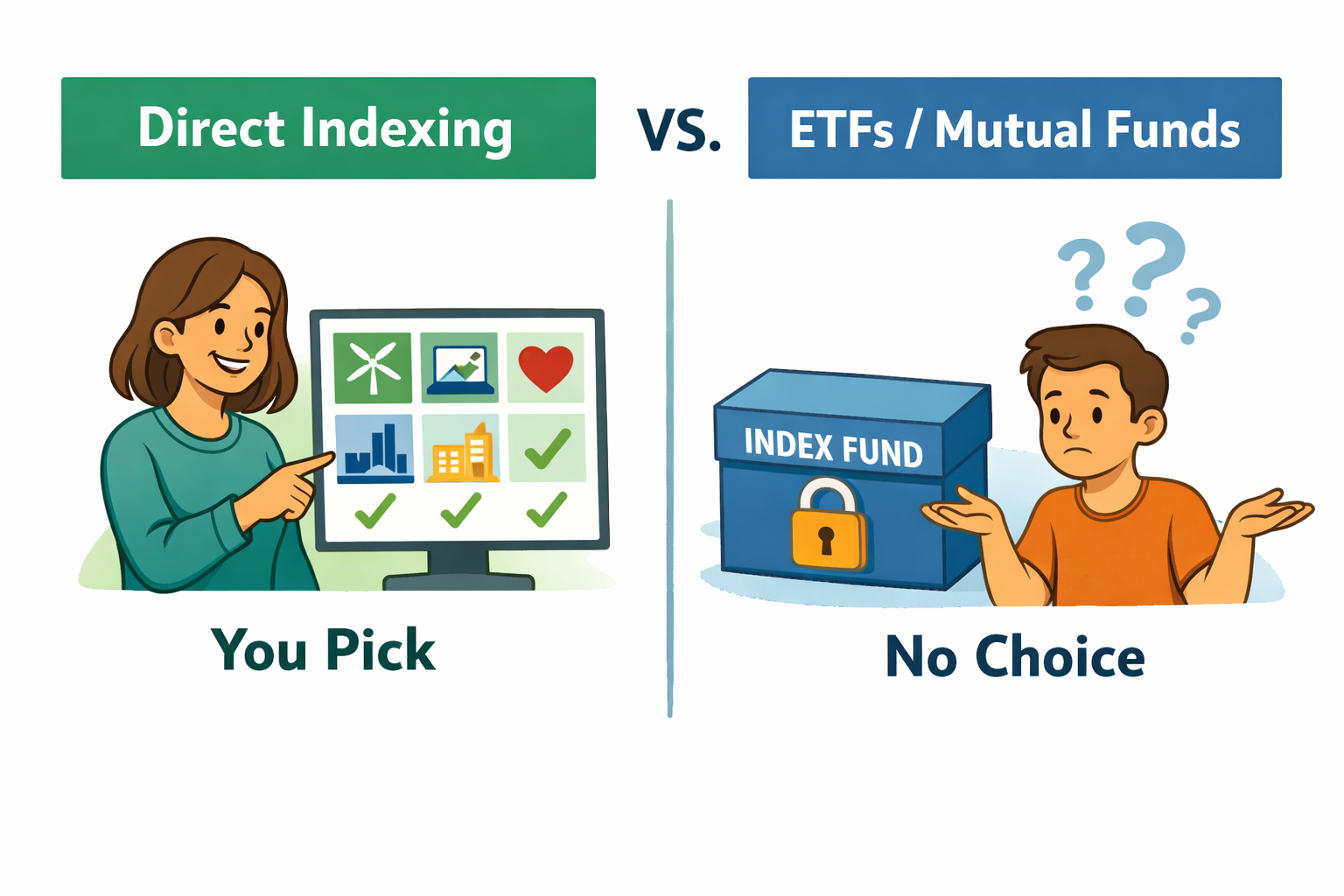
Direct indexing has moved from institutional portfolios into the hands of individual investors. It’s often touted as “owning the index, but better.” The reality is more nuanced. Direct indexing is a powerful tool for investor control, customization, and tax efficiency—but it also introduces complexity, tracking error, and operational demands that aren’t worth it for every investor.
For experienced investors, the right question isn’t whether direct indexing is better than ETFs. It’s when does direct indexing produce superior after-tax outcomes—and when is a simple ETF still the smarter choice?
What is Direct Indexing?
Direct indexing is a portfolio construction strategy where you own the individual securities of an index directly, rather than buying a single ETF or mutual fund. Instead of holding one fund, you hold dozens or hundreds of stocks, weighted to resemble an index fund or ETF. This structure allows investors to customize exposures, and tax loss harvest at the individual security level—at the cost of added complexity and operational overhead.
Direct Indexing vs. ETFs: What are the key differences?
At a high level, both approaches aim to deliver index-like returns. The meaningful differences show up in implementation and outcomes.
Ownership and Control
- ETFs and Mutual Funds: In either case, an investor owns shares of a fund. The fund controls the investment composition, trading, rebalancing, and tax management. Investors can choose to own the ETF/mutual fund, or not, but there’s no room for customization of it.
- Direct Indexing: You own the underlying securities individually. You control investment composition (what to trade), tilts (which means choosing to overweight or underweight factors, more on this below), and tax decisions.
Tracking Precision
- ETFs generally track their index closely, with minimal tracking error.
- Direct indexing portfolios accept some tracking deviation in exchange for flexibility and tax optimization.
If matching index returns perfectly is the primary goal, ETFs or mutual funds usually perform better.
Direct Indexing Tax Benefits
The most compelling case for direct indexing is taxes—specifically, tax loss harvesting at scale.
Individual-Security Tax Loss Harvesting
Because each stock is held separately, losses can be harvested continuously across the portfolio, even when the overall index is up. This creates more frequent and diversified opportunities to realize losses compared to an ETF or mutual fund, where gains and losses are pooled.
Direct Indexing Tax Benefits Over Time
- Greater volume of harvestable losses
- Losses generated without exiting market exposure
- Accumulated loss carryforwards usable against future gains
These benefits compound over multiple years, particularly for active investors who regularly realize gains elsewhere.
After-Tax Benchmarking Matters
The real question isn’t how a direct indexing strategy performs pre-tax—it’s whether the additional tax alpha translates into higher after-tax returns versus a comparable ETF, mutual fund, or index benchmark.
A Concrete Example: Tax Alpha in Practice
Consider a $1,000,000 taxable portfolio tracking a broad U.S. equity index.
- ETF approach: The investor holds a single ETF. During a volatile year, the ETF finishes up modestly, but there are limited opportunities to realize losses. Capital gains elsewhere in the portfolio are largely taxable.
- Direct indexing approach: The same index is held as ~300 individual stocks. Throughout the year, dispersion between winners and losers allows the investor to harvest losses in individual stocks—even while the overall index is flat or up.
Assume the direct indexing portfolio generates $40,000 in harvested losses over the year:
- Those losses offset $40,000 of realized capital gains elsewhere.
- At a 20% long-term capital gains rate, that’s roughly $8,000 in federal tax savings.
Over multiple years, repeated harvesting can accumulate significant loss carryforwards. When measured against an ETF on an after-tax basis, the direct indexing portfolio can meaningfully outperform—even if pre-tax returns are similar.
Key Benefits of Direct Indexing: Custom Factor Tilts and Exclusions
Direct indexing allows investors to customize portfolios in ways ETFs or mutual funds can’t. The two main benefits for investors are being able to adjust the weighting of factors and the ability to exclude stocks as desired by the investor.
Factor Tilts
Investors can overweight or underweight factors such as:
- Value
- Momentum
- Quality
- Low volatility
Unlike factor ETFs, these tilts can be layered onto a broad index rather than replacing it. Using Accountable Finance’s AI Strategy Tool investors can apply different factor tilts to a direct indexing strategy, then simulate and backtest results to see how different factor tilts could impact performance.
ESG and Values-Based Customization
Direct indexing makes it possible to:
- Exclude specific companies or industries
- Apply ESG constraints without abandoning index exposure
- Adjust holdings as personal or regulatory requirements evolve
This level of customization is difficult—or impossible—to achieve cleanly with off-the-shelf ETFs or mutual funds. For investors who care about ESG considerations, direct indexing can allow for more customization of holdings in line with investor values, but still tie the investing strategy to a performance index.
Direct Indexing Downsides: Portfolio Complexity and Operational Overhead
The flexibility of direct indexing comes with real costs in terms of complexity and execution risk, but tools like Accountable Finance can help investors smartly manage direct indexing.
Increased Complexity
- Hundreds of investment line items instead of one ETF or mutual fund
- Frequent rebalancing and harvesting decisions may be necessary to realize tax loss harvesting benefits fully
- Increased data and tax reporting requirements
Execution Risk
Poorly managed direct indexing can lead to:
- Excessive tracking error
- Wash sale violations across accounts, which have tax implications
- Unintended factor drift
Without robust aggregation and monitoring, the increased complexity can overwhelm the benefits for investors.
When to Choose Direct Indexing
Direct indexing tends to outperform ETFs and mutual funds on an after-tax basis when:
- Portfolio size is large enough to justify the additional complexity
- The investor is in a higher tax bracket
- Tax loss harvesting opportunities are meaningful (often when the assets are more volatile)
- Custom exclusions or tilts are important to the investor
- Performance is evaluated after tax, not just pre-tax
For these investors, control and tax efficiency can outweigh modest tracking errors.
When ETFs and Mutual Funds Are Still the Better Choice
ETFs and mutual funds remain superior when:
- Simplicity and low maintenance are priorities
- Portfolio size is small or moderate
- The investor has limited taxable gains
- Perfect index tracking is desired
- Behavioral discipline matters more than customization
In many cases, ETFs and mutual funds deliver “good enough” outcomes with much less effort when compared to direct indexing.
Measuring Success: After-Tax, Benchmark-Relative Returns
Whether using ETFs, mutual funds, or direct indexing, success should be measured consistently:
- After-tax returns
- Relative to an appropriate benchmark
- Over a full market cycle
Without this lens, it’s impossible to tell whether added complexity is actually improving outcomes—or just creating additional work and activity.
Why Direct Indexing Appeals to Investors
Direct indexing aligns with investors who want to:
- Be intentional about portfolio construction
- Optimize for taxes, not just expense ratios
- Customize exposure without abandoning diversification
- Measure results with rigor and transparency
But like tax loss harvesting, direct indexing is a tool—not a default choice. Its value depends on thoughtful execution, clear benchmarks, and the ability to see the entire portfolio in context.
For active investors focused on outcomes, the advantage isn’t simply owning the index—it’s understanding how every decision affects after-tax results.
Create a Direct Indexing Strategy with Accountable Finance
Direct indexing only delivers value when it’s designed and monitored deliberately. Accountable Finance’s AI Strategy Creator helps investors create and backtest direct indexing portfolios, and apply factor tilts or exclusions before needing to make investments.
👉 Create and evaluate a direct indexing strategy with Accountable Finance