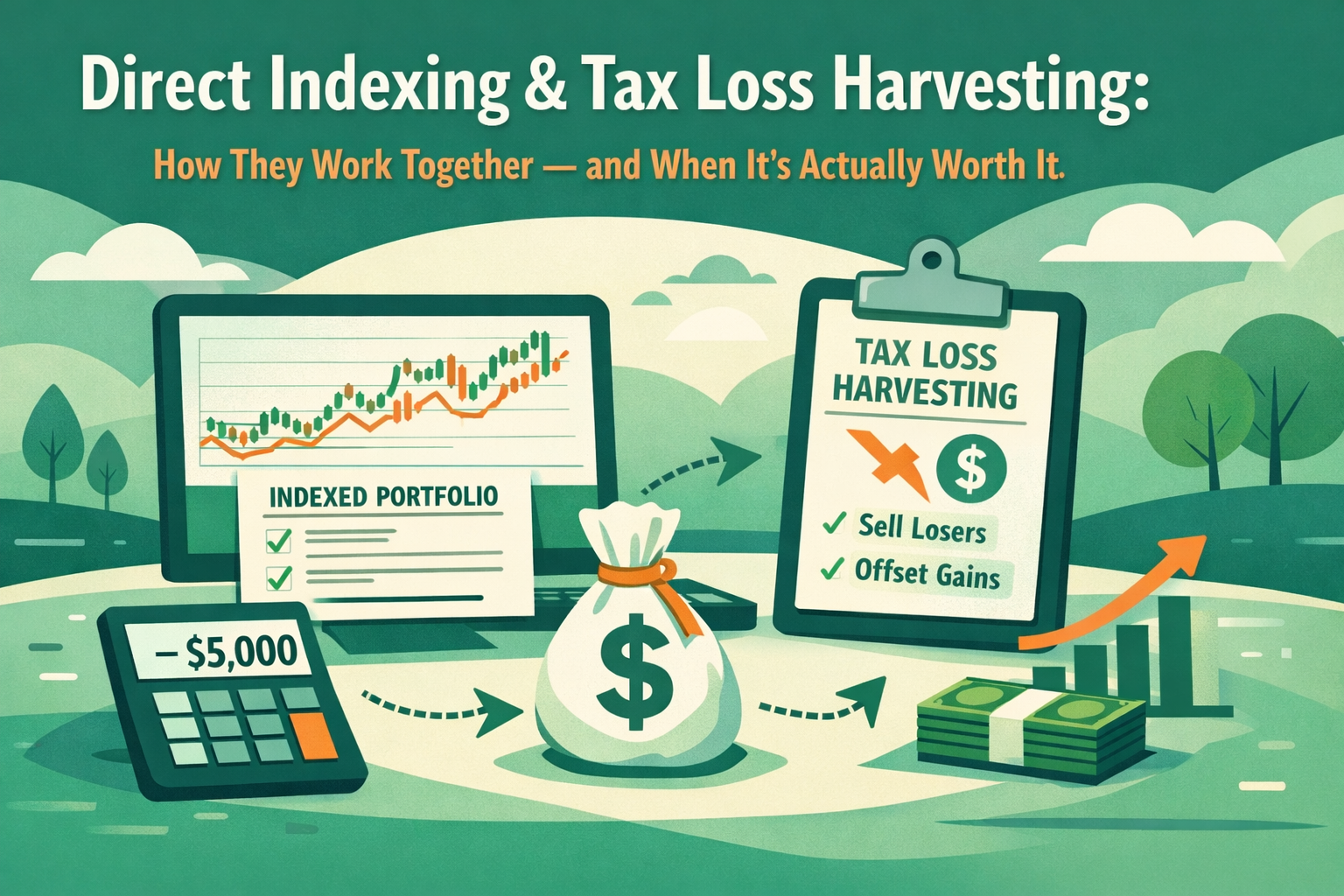
Direct indexing and tax loss harvesting (TLH) are often discussed separately. But in practice, they are most powerful when used together as part of an investing strategy. Direct indexing is the structure; tax loss harvesting is the engine. When combined thoughtfully, they can materially improve after-tax outcomes—far beyond what’s possible with a traditional ETF or mutual fund.
For experienced investors evaluating whether the added complexity is justified, the real question is not whether direct indexing can enable tax loss harvesting. What’s important is determining if the tax benefits are large enough to outweigh the trade-offs, or not.
Direct Indexing + Tax Loss Harvesting Explained
Tax loss harvesting works by realizing investment losses to offset capital gains. The limitation with ETFs or a mutual fund is simple: you own one security. When that security is up, there are no losses to harvest—even if many of the underlying stocks are down.
Direct indexing changes the unit of ownership.
Instead of holding one ETF or mutual fund, you hold hundreds of individual securities that collectively resemble an index and mimic an ETF or mutual funds assets. That structure unlocks direct indexing tax loss harvesting at the individual security level:
- Some stocks are up
- Some stocks are down
- Losses can be harvested continuously
- Overall index exposure is maintained
This is why tax loss harvesting with direct indexing can increase after-tax outcomes in a way ETFs and mutual funds fundamentally cannot.
Learn More About Direct Indexing >> Direct Indexing for Investors: Strategy, Trade-Offs, and When It Beats ETFs
How Tax Loss Harvesting Works Inside a Direct Index Portfolio
Individual Security Ownership
In a direct index portfolio, each stock is held directly in your account. Losses are realized one security at a time, rather than at the fund level.
This allows investors to:
- Harvest losses even when the index is flat or rising
- Avoid selling the entire portfolio to generate tax benefits
- Target losses without abandoning diversification
Continuous vs. Occasional Harvesting
With ETFs or mutual funds, harvesting opportunities tend to be episodic—often concentrated around market drawdowns.
With direct indexing, dispersion between stocks creates harvesting opportunities throughout the year. Losses can be realized opportunistically as they appear, rather than waiting for broad market declines.
Maintaining Index Exposure
After harvesting a loss, the proceeds are reinvested into replacement securities that preserve index-like exposure. The goal is tax efficiency—not market timing.
Learn More About Tax Loss Harvesting >> Tax Loss Harvesting for Investors: When It Works, When It Doesn’t, and How to Do It Right
Direct Indexing Tax Advantages (With Example Numbers)
Consider a $1,000,000 taxable portfolio tracking a broad U.S. equity index.
ETF/Mutual Fund Scenario
- The investor holds a single ETF or mutual fund.
- The index finishes the year up 6%.
- There are minimal opportunities to harvest losses.
- $50,000 of gains realized elsewhere in the portfolio are largely taxable.
Direct Indexing + Tax Loss Harvesting Scenario
- The same index is held as ~300 individual stocks.
- Market dispersion allows $45,000 of losses to be harvested during the year.
- Overall index exposure is maintained through reinvestment.
Tax impact:
- $45,000 in losses offset $45,000 in capital gains
- At a 20% long-term capital gains rate, that’s ~$9,000 in federal tax savings
Why After-Tax Performance Matters in Investing
Pre-tax, both investing portfolios look similar. After-tax, the direct indexing portfolio compounds from a higher base—especially if harvested losses accumulate and are deployed year after year.
This is the core of the direct indexing tax benefits story: tax alpha that doesn’t show up in gross returns.
When Direct Indexing and Tax Loss Harvesting Is Actually Worth It
Direct indexing combined with tax loss harvesting tends to make sense when:
- Portfolio size is large enough to generate meaningful losses
- The investor is in a higher marginal tax bracket
- The portfolio experiences regular volatility and dispersion
- Capital gains are realized elsewhere (rebalancing, active strategies, liquidity events)
In these cases, the tax savings can outweigh fees, possibility of tracking error, and additional complexity.
When Direct Indexing and Tax Loss Harvesting is Not Worth It
Despite its appeal, this strategy isn’t universally a great idea for investors.
It’s often not worth it when:
- Portfolio balances are small
- Capital gains taxes are minimal
- The investor follows a strict buy-and-hold approach
- Simplicity and low maintenance are the top priorities
In these scenarios, ETFs and mutual funds may deliver nearly identical after-tax outcomes with far less effort and risk of error.
Important Trade-Offs and Risks to Understand
Complexity
Direct indexing portfolios involve hundreds of positions, frequent trades, and ongoing monitoring.
Tracking Error
Harvesting losses and applying constraints introduces deviation from the index. For investors who demand tight tracking, this can be uncomfortable.
Wash Sale Management Across Accounts
Wash sale rules apply across all accounts and brokerages. Without aggregated visibility, harvesting activity in one account can be invalidated by purchases in another.
This is where execution—not theory—often breaks down.
Accountable Finance can aggregate accounts to help investors get a full picture of performance across accounts and avoid visibility issues.
How to Measure Success (The Part Most People Miss)
The success of a direct indexing tax loss harvesting strategy should be measured:
- On an after-tax basis
- Relative to an appropriate benchmark (e.g., ETF, mutual fund, or index equivalent)
- Over multiple years
Gross returns alone are misleading. A strategy that underperforms pre-tax can still win if after-tax outcomes are superior.
Without after-tax benchmarking, investors can’t tell whether added complexity is producing real value—or just more activity.
Make a Smart Decision for Your Portfolio
Direct indexing and tax loss harvesting work best as a system, not as isolated tactics. Together, they can create durable tax advantages that ETFs or mutual funds structurally can’t match.
But the benefits are conditional. Portfolio size, tax rates, volatility, and execution discipline all matter.
For investors willing to measure what matters and manage complexity deliberately, the combination can be powerful. For others, simplicity may still win.
👉 Create and evaluate a direct indexing strategy with Accountable Finance